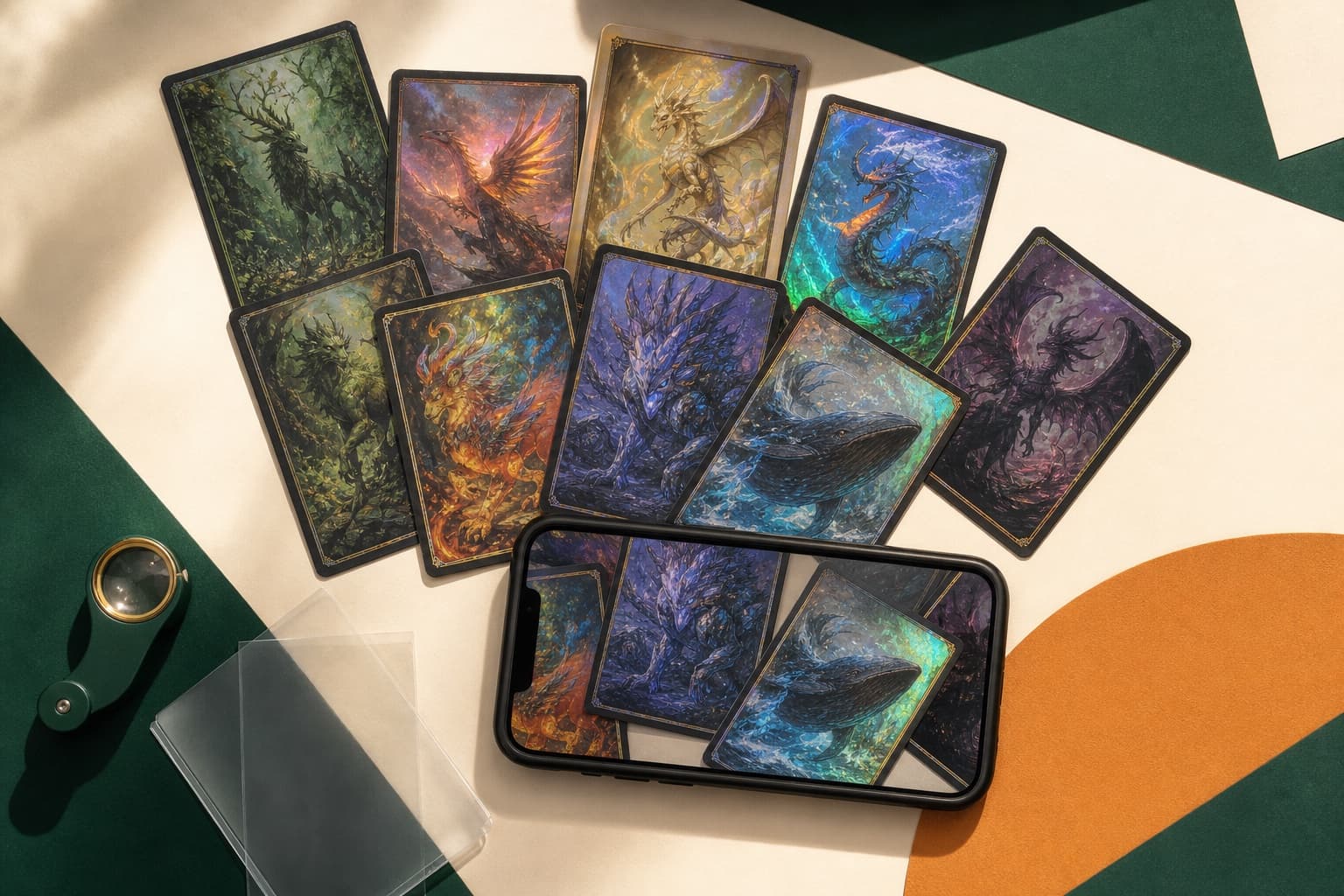
Confirm that the photo represents fixed inventory
The first question is whether the pictured cards are the cards included. Avoid mystery lots, random selections, representative images, repacks, and listings where the seller chooses the inventory after purchase.
Compare the title, description, advertised quantity, and all available photos. If they describe different inventory, the uncertainty exists before card identification begins.
Scan for Pokémon-specific visible treatments
Look for supported holo or reverse-holo surfaces, illustration or full-art layouts, and recognizable ex, GX, V, VMAX, VSTAR, AR, CHR, or related treatments. Use the correct category vocabulary; football rookie, patch, and serial-number rules do not apply to Pokémon lots.
A reflective sleeve, binder page, strong lighting, or colorful seller background is not a card treatment. Require a card-face reason and record confidence when glare or distance makes the observation uncertain.
Identify only what can be read
Start with the clearest foreground cards. Record a name, set clue, card number, language, treatment, variant, grade, and condition observation only when the photo supports it. Similar artwork and reprints make partial matches risky.
For a dense image, an honest result may include a few resolved subjects and many unresolved cards. Do not assign an average category value to the unreadable remainder. Keep it as residual inventory at zero in exact card-level valuation.
Use thresholds to prevent one-card promotion
A base-heavy Pokémon lot should not become a strong candidate because one recognizable card is visible. Require multiple visibly supported non-base treatments and a meaningful share of the visible inventory before using premium-content evidence to preserve viability.
For large low-cost collections, the advertised quantity and delivered cost per card can support review when the image independently shows enough non-base treatment evidence. Completeness, identity, condition, and authenticity remain unverified.
Calculate the business case conservatively
Measure delivered cost per advertised, visible, sellable, and target-range card. Separate meaningful inventory from residual bulk and estimate how many transactions the lot may require.
Use supported completed-sale evidence for profit, ROI, and offer guidance. Keep photo estimates labeled. Subtract resale fees, shipping, packaging, risk reserve, and labor before deciding whether the lot fits your strategy.